


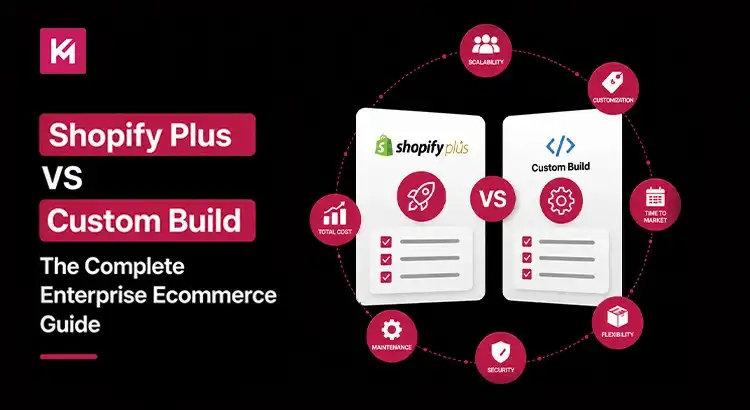
Shopify Plus vs Custom Build: The Complete Enterprise Ecommerce Guide
Shopify Plus is the enterprise version of Shopify, built for businesses that have moved beyond basic e-commerce needs. It’s designed for brands handling higher sales volumes, complex operations, international customers, and the need for a more scalable online store.
Unlike traditional e-commerce setups, where you manage hosting, security, updates, and technical infrastructure yourself, Shopify Plus works as a managed platform. You’re not building the foundation from scratch. You’re building your business on top of an infrastructure that already exists. For many enterprise brands, this is the biggest advantage. A business owner who wants to launch faster, reduce technical headaches, and focus more on marketing, customers, and growth often finds Shopify Plus attractive.
Key Features of Shopify Plus

Scalability Without Managing Infrastructure
One of the biggest concerns for growing e-commerce businesses is whether their platform can handle growth. A sudden traffic spike during a product launch, seasonal sale, or promotional campaign can create serious problems if your infrastructure isn’t prepared.
But when you choose Shopify Plus, you are actually safe, as it removes much of that concern because hosting and performance management are handled by Shopify. You don’t have to worry about upgrading servers, handling traffic spikes manually, or managing technical maintenance behind the scenes.
Advanced Customization Options
A common misconception is that Shopify Plus only works for businesses that want a basic template-based website. That’s not true. Shopify Plus allows businesses to create highly customized e-commerce experiences through custom themes, checkout customization, APIs, and integrations.
For example, a premium clothing brand might want a unique product discovery experience, personalized recommendations, and a smoother checkout flow. Shopify Plus gives developers the flexibility to create those experiences while staying within the Shopify ecosystem.
However, there is still a limit. You’re customizing within Shopify’s framework. You’re not creating an entirely new e-commerce system from the ground up.
Multi-Channel Selling
Modern e-commerce isn’t limited to one website. Customers may discover products through social media, marketplaces, mobile devices, physical stores, or other sales channels. Shopify Plus supports businesses that want to manage multiple selling channels from one platform.
For example, a beauty brand selling through its website, social platforms, and retail locations can manage operations more efficiently without handling separate systems.
Automation and Business Efficiency
As businesses grow, manual tasks become expensive. Shopify Plus includes automation tools that help reduce repetitive work. You can automate:
- Order management processes
- Customer segmentation
- Inventory workflows
- Marketing tasks
- Internal operations
This helps teams spend less time managing small tasks and more time focusing on growth.
Why Businesses Choose Shopify Plus

The biggest reason companies choose Shopify Plus is balance. They want enterprise-level capabilities without the complexity of managing a fully custom e-commerce platform.
Faster Time to Market
A custom e-commerce platform can take months or even longer, depending on complexity. With Shopify Plus, businesses can launch much faster because the core infrastructure is already available. This matters when market timing is important.
For example, a growing fashion brand preparing for international expansion may not want to spend a year building a platform before entering new markets. Shopify Plus allows them to move quickly.
Lower Maintenance Requirements
A custom-built e-commerce platform requires ongoing technical involvement. Updates, security patches, performance improvements, and bug fixes all need attention.
With Shopify Plus, much of the platform maintenance is handled by Shopify. Your development team can focus more on improving the customer experience instead of maintaining the foundation.
Strong Ecommerce Ecosystem
Another advantage is the Shopify ecosystem. Businesses have access to:
- App integrations
- Development partners
- Payment solutions
- Marketing tools
- Third-party services
This makes expanding your store easier compared to building every feature independently.
Understanding Custom-Built Ecommerce Solutions
A custom-built e-commerce solution is exactly what it sounds like: a platform designed and developed specifically around your business requirements. Instead of adapting your business processes to fit an existing platform, you create a system that fits your operations.
This approach gives you maximum flexibility. But it also requires more planning, investment, and technical expertise. A custom e-commerce platform is usually considered when standard platforms cannot handle specific business needs.
Why Businesses Choose Custom Ecommerce Development

Complete Control Over Functionality
With a custom build, you decide how everything works. You’re not limited by existing platform structures. You can create:
- Unique checkout processes
- Custom pricing systems
- Advanced customer dashboards
- Complex product configurations
- Specialized B2B buying experiences
For example, a manufacturing company selling products with hundreds of variations, custom quotes, and approval workflows may find a custom solution more suitable than forcing those processes into a standard e-commerce platform.
Unlimited Design Freedom
A custom-built store allows complete control over the user experience. Every interaction can be designed around your customers. From navigation to product discovery to checkout, everything can be created based on your specific goals. This matters for brands where customer experience is a major competitive advantage.
A luxury brand, for example, may not want a typical e-commerce journey. They may need a highly personalized experience that matches their offline brand identity.
Better Alignment With Unique Business Models
Not every e-commerce business operates the same way. Some companies sell directly to consumers. Others manage:
- Wholesale customers
- Dealer networks
- Subscription models
- Custom product requests
- Enterprise accounts
When your business model is unique, a custom e-commerce solution can provide the flexibility needed to support those operations.
Shopify Plus vs Custom Build: Key Differences
| Factor | Shopify Plus | Custom Build |
|---|---|---|
| Development Time | Faster launch | Longer development process |
| Initial Cost | Lower investment | Higher upfront cost |
| Customization | High but within the Shopify framework | Almost unlimited flexibility |
| Maintenance | Lower maintenance responsibility | Requires ongoing technical management |
| Hosting | Managed by Shopify | Managed by your team/provider |
| Security | Shopify handles platform security | Your team manages security |
| Ownership | Platform-based ownership | Full control and ownership |
| Scalability | Excellent for most enterprise brands | It depends on the architecture quality |
Shopify Plus vs Custom Build: Cost Comparison
Price is one of the biggest factors when businesses compare these options. But the cheapest option upfront isn’t always the most cost-effective option long term.
Shopify Plus Pricing
Shopify Plus pricing depends on your business requirements, sales volume, and agreement with Shopify. Generally, enterprise businesses should expect costs to include:
- Shopify Plus subscription fees
- Development and customization costs
- App subscriptions
- Integration expenses
- Ongoing optimization
A Shopify Plus project can range from tens of thousands of dollars for development and customization to significantly higher investments for complex enterprise requirements. The advantage is that you’re investing in a proven platform instead of building everything yourself.
Custom Ecommerce Development Pricing
Custom-built e-commerce platforms usually require a larger initial investment. Costs may include:
- Strategy and planning
- UX/UI design
- Backend development
- Frontend development
- Third-party integrations
- Testing
- Hosting setup
- Ongoing maintenance
A custom e-commerce solution can easily cost significantly more than Shopify Plus because every component needs to be designed, built, and maintained. However, businesses with unique requirements may see the investment as worthwhile because the platform is built specifically for them.
Which One Gives Better Value?
It depends on what you’re trying to achieve. If your priority is launching quickly, scaling efficiently, and avoiding unnecessary technical complexity, Shopify Plus is often the smarter choice. If your business depends on unique workflows, custom functionality, or complete control over every part of the e-commerce experience, a custom build may provide better long-term value.
The real question isn’t:
“Which platform is better?”
It’s:
“What does your business need that your e-commerce platform must support?”
Shopify Plus vs Custom Build: Which One Offers Better Customization?
Customization is where the difference between Shopify Plus and custom-built e-commerce solutions becomes much clearer.
With Shopify Plus, you get a powerful foundation that can be customized heavily. You can modify your storefront design, create unique shopping experiences, integrate third-party systems, and improve the checkout journey. But there are still platform boundaries.
You’re working within Shopify’s ecosystem. The platform provides the structure, and you customize that structure based on your needs. A custom-built e-commerce solution works differently. You’re creating the structure itself. This means you can build almost anything your business requires without worrying about whether the platform supports it.
For example, imagine you run a B2B e-commerce company where every customer gets different pricing based on contracts, order volume, location, and purchase history.
A custom build can create that exact experience from the beginning. Shopify Plus can also support complex B2B requirements, but you may need additional apps, integrations, or development work to achieve the same result.
Scalability: Shopify Plus vs Custom Build
Growth is usually the reason businesses start looking beyond their current e-commerce platform. More products, more customers, more orders, and more operational complexity can expose weaknesses in your existing system. Both Shopify Plus and custom-built platforms can scale, but they approach scalability differently.
Shopify Plus Scalability
Shopify Plus is built to support high-volume e-commerce brands. It can handle:
- Large product catalogues
- High traffic volumes
- Multiple sales channels
- International expansion
- Large order volumes
The advantage is simplicity. You don’t need to constantly manage infrastructure as your business grows. A brand preparing for a major seasonal campaign or global expansion can focus on sales instead of worrying about whether the website will survive the traffic.
Custom Build Scalability
Custom solutions offer scalability through architecture. A well-built custom platform can be designed around your future growth plans. You can decide:
- How your database works
- How your systems communicate
- How your backend handles operations
- How new features are added
However, scalability depends heavily on the quality of development. A poorly built custom platform can become expensive and difficult to improve later. That’s why planning matters so much with custom development.
Security Comparison: Shopify Plus vs Custom Ecommerce
Security is something many businesses overlook until there’s a problem. An e-commerce website handles sensitive information every day, including customer details, payments, and transaction data.
Shopify Plus Security
Shopify Plus provides managed security infrastructure. This includes:
- Secure hosting
- Platform updates
- PCI compliance support
- Infrastructure monitoring
For many businesses, this removes a major responsibility from their internal teams. You’re not spending time worrying about server security or platform maintenance.
Custom Ecommerce Security
With a custom build, security responsibility sits with your development team. You have more control, but you also have more responsibility. Your team needs to manage the following:
- Security updates
- Vulnerability testing
- Hosting protection
- Data protection practices
A custom platform can be extremely secure when built properly, but it requires continuous attention.
Practical Examples: When Shopify Plus Makes Sense vs Custom Build
The right choice becomes easier when you look at real business situations. Imagine a premium skincare company that has grown from a small online store into an international brand.
They need:
- Multiple currencies
- Faster checkout
- Better marketing automation
- A smoother mobile shopping experience
- Integration with inventory tools
Shopify Plus could be a strong fit because the business needs growth support, not a completely unique e-commerce engine. Now consider a company selling industrial equipment. Their customers need:
- Custom product configurations
- Quote requests
- Dealer accounts
- Approval-based purchasing
- Complex pricing rules
A custom-built ecommerce solution may make more sense because the buying process doesn’t follow a traditional online shopping journey. The platform needs to adapt to the business. Not the other way around.
How to Choose Between Shopify Plus and Custom Build
Before making a decision, look at your business from a long-term perspective. A platform should support where you’re going, not only where you are today. Ask yourself:
-
How Complex Is Your Customer Journey?
If customers follow a standard path:
Browse → Add to Cart → Checkout → Purchase
Shopify Plus may handle your needs effectively. If your customers require custom journeys, approvals, configurations, or special workflows, custom development may be a better option.
-
How Much Control Do You Need?
Do you need complete control over every feature and interaction? Or do you need a reliable platform that allows you to customize the important parts?
- Shopify Plus gives flexibility.
- Custom development gives ownership.
The choice depends on how much control your business actually needs.
-
What Is Your Budget?
A budget is not only about the initial investment. Think about:
- Development costs
- Maintenance
- Future updates
- Internal resources
- Long-term improvements
Shopify Plus usually requires less technical management. Custom solutions require a bigger commitment but may deliver stronger value for businesses with unique needs.
-
What Will Your Business Look Like in Five Years?
This is one of the most important questions. A platform that works today might create limitations later. Think about your future plans:
- International expansion
- More product lines
- New sales channels
- B2B growth
- Operational complexity
The right ecommerce solution should support that journey.
Shopify Plus vs Custom Build: Final Comparison
| Category | Shopify Plus | Custom Build |
|---|---|---|
| Best For | Growing enterprise brands | Businesses with unique requirements |
| Cost | Lower initial investment | Higher upfront investment |
| Launch Speed | Faster | Slower |
| Flexibility | High | Maximum |
| Maintenance | Easier | Requires ongoing management |
| Ownership | Limited to the platform ecosystem | Full ownership |
| Security | Managed by Shopify | Managed by your team |
| Technical Requirements | Lower | Higher |
| Long-Term Control | Limited by platform | Complete control |
Need Help Choosing the Right E-commerce Approach?
Choosing between Shopify Plus and a custom-built e-commerce solution isn’t just a technology decision. It’s a business decision. The right platform should match your growth plans, customer expectations, and operational needs.
At Kinex Media, we help businesses evaluate their e-commerce requirements, choose the right platform, and build experiences that are designed for long-term growth.
Whether Shopify Plus fits your goals or your business needs a completely custom e-commerce solution, the right strategy starts with understanding what you actually need.
Talk to our e-commerce experts today and find the right approach for your next stage of growth.
The Bottom Line – And What You Should Do Next
Building custom gives you ultimate freedom but demands serious time, money, and ongoing effort. Shopify Plus trades some of that absolute control for faster results, better reliability, often lower long-term costs, and the freedom to focus on growing your sales instead of fighting tech issues.
But here’s the thing: there’s no single answer that fits everyone. Your business is unique. The right choice depends on your revenue, your team, your goals, and how much you hate dealing with tech headaches.
So, what’s holding your store back right now? If you’re ready to get clear on the best path forward, reach out to the team at Kinex Media. Whether you need help auditing your current setup, exploring a Shopify Plus migration, or building something truly custom, they’ve got the experience to guide you.
Ready to take that next step? Book a quick call with Kinex Media today or start by reviewing your analytics and costs. Your future self and your bottom line will thank you for making a smart move now.

